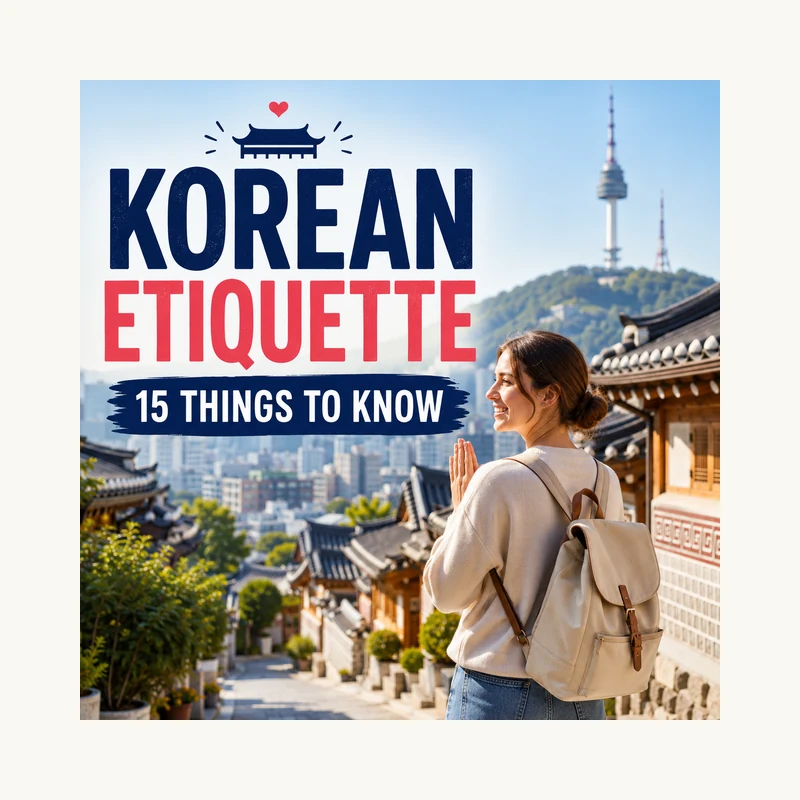
Visiting South Korea for the first time?
You may have seen videos telling you there are dozens of Korean etiquette rules you absolutely must follow.
Don’t worry.
Koreans don’t expect international visitors to understand every social rule, and making a small cultural mistake isn’t going to ruin your trip.
Still, knowing a few basics can make everyday situations easier — especially in restaurants, homes, public transportation, and when interacting with older people.
Here are 15 Korean etiquette tips for tourists that are actually useful to know before your trip.
1. You Usually Don’t Need to Tip in Korea 💰
Let’s start with an easy one.
Tipping is generally not part of everyday Korean service culture.
At most restaurants, cafés, taxis, and ordinary services, you simply pay the displayed or charged amount.
You don’t need to calculate an extra 15% or 20% after every meal.
In fact, leaving cash behind on a restaurant table may cause confusion because staff could think you accidentally forgot your money.
There are exceptions, particularly certain tourist-oriented or premium services, but for everyday travel:
No tip is normally expected.
PICK KNOW TIP 🇰🇷
If a specific business clearly states a service charge or tipping policy, follow that business’s policy. Otherwise, don’t stress about tipping.
2. Don’t Be Afraid to Call Restaurant Staff
In some countries, loudly getting a server’s attention can feel rude.
Korea is different.
At many Korean restaurants, servers won’t continuously come to your table to check whether you need something.
Instead, you may find a call button on the table.
Press it when you need:
- More food
- Drinks
- Extra utensils
- Help ordering
- The bill
No button?
You may hear customers say:
저기요! (Jeogiyo!)
It roughly means “Excuse me!” when getting someone’s attention.
Used normally in a restaurant, this isn’t automatically rude.
3. Water and Side Dishes May Be Self-Service
Don’t assume a server forgot about you if nobody brings water.
Many casual Korean restaurants have a self-service area marked:
셀프 (self)
You may need to get your own:
- Water
- Cups
- Utensils
- Napkins
- Additional side dishes
Some restaurants refill certain banchan (side dishes) without an extra charge, while others may have different policies.
Look around for a self-service station or ask before assuming.
4. Take Your Shoes Off When Appropriate 👟
You don’t remove your shoes everywhere in Korea.
You do normally remove them before entering someone’s home.
You may also encounter restaurants, traditional accommodations, temples, or other spaces where shoes should be removed before entering a raised indoor area.
Usually, the environment makes this obvious.
Look for:
- Shoes lined up near the entrance
- A shoe rack
- A raised floor
- Slippers
- A clear transition between the entrance and indoor space
When in doubt, look at what everyone else is doing.
PICK KNOW TIP 🇰🇷
The easiest rule isn’t “always remove your shoes.” It’s “check the entrance.”
5. Using Two Hands Can Show Respect
You may notice Koreans using both hands when giving or receiving something, particularly in more formal situations or when interacting with an older person.
This can apply to:
- Gifts
- Business cards
- Drinks
- Money
- Important objects
You don’t need to dramatically use both hands every time a cashier gives you a receipt.
But in a respectful or formal interaction, receiving something with two hands — or supporting your right arm with your left hand — can be a polite gesture.
6. Be Careful With Priority Seats on Public Transportation 🚇
Seoul’s subway and buses have designated seating for passengers who may need it.
These can include seats intended for:
- Older adults
- People with disabilities
- Pregnant passengers
- Passengers with infants
The safest approach for visitors is simple:
Pay attention to the signs and give priority to people who need the designated seating.
You may notice some priority seats remain empty even when a train is busy.
You don’t need to copy every local behavior perfectly — just respect the purpose of the seats.
7. Keep Your Voice Reasonable on Public Transportation
Korean subways can be extremely crowded while still being relatively quiet.
People watch videos, message friends, listen to music, or sleep during their commute.
Having a normal conversation is fine.
But loud phone calls, speakerphone conversations, or playing videos without headphones can attract unwanted attention.
Think:
Conversation = fine
Your entire subway car hearing your TikTok = not ideal.
8. Escalator Rules Are More Complicated Than You Think
You may see people standing to one side of an escalator and leaving the other side open for people walking.
But don’t treat this as an official rule that you must follow everywhere.
Safety guidance can discourage walking or running on escalators, and behavior can vary by location.
The practical tourist rule is:
Don’t block people unnecessarily, but don’t run up or down escalators just because everyone looks busy.
Follow posted signs where available.
9. Public Trash Cans Can Be Hard to Find 🗑️
One thing that surprises many first-time visitors:
You may have trouble finding a public trash can.
Especially while walking around busy shopping or residential areas.
If you buy street food or a drink and can’t find somewhere to throw the packaging away, don’t leave it on the street.
Keep a small plastic bag in your backpack and carry the trash until you find an appropriate bin.
Convenience stores and cafés have their own waste facilities, but don’t assume every business wants you bringing unrelated outside trash inside.
10. Don’t Be Surprised If Someone Asks Your Age
Depending on the social situation, Koreans may ask your age earlier in a conversation than you’re used to.
Why?
Age has traditionally influenced how people address each other and which level of Korean speech feels appropriate.
That doesn’t mean every Korean person you meet will immediately demand your birth year.
Among tourists and in casual interactions, it may never come up.
But if someone asks:
“How old are you?”
they may be trying to understand the social relationship rather than making a judgment about how old you look.
11. You Don’t Need to Master Korean Honorifics
The Korean language has different levels of formality.
You’ve probably heard:
존댓말 (jondaetmal) — polite/formal speech
반말 (banmal) — casual speech
As a tourist, nobody realistically expects you to master Korean speech levels.
If you’re learning a few Korean phrases, use the polite forms.
For example:
안녕하세요 (Annyeonghaseyo)
Hello
감사합니다 (Gamsahamnida)
Thank you
죄송합니다 (Joesonghamnida)
I’m sorry / Excuse me
Those three alone will get you surprisingly far.
PICK KNOW TIP 🇰🇷
A polite tone and a smile are more useful than trying to memorize twenty complicated honorific rules the night before your flight.
12. Korean Drinking Culture Has Its Own Etiquette 🍻
Traditional Korean drinking culture contains many customs, particularly when drinking with older people or in formal groups.
You may see people:
- Pour drinks for others
- Receive drinks with two hands
- Avoid leaving someone’s glass empty
- Turn slightly away when drinking in front of a respected elder
Do tourists need to memorize all of this?
No.
If you’re drinking casually with Korean friends, simply observe what others are doing.
And if someone teaches you a drinking custom, that’s usually part of the fun.
One rule matters everywhere:
You never have to drink alcohol just because someone offers it.
Politely declining is fine.
13. Don’t Start Eating Too Early at a Formal Meal 🍚
At a casual meal with friends, nobody is going to conduct an etiquette exam.
But in a more traditional or formal meal with older people, it can be polite to wait until the eldest person begins eating.
You’ll also notice Korean meals often involve shared dishes in the middle of the table.
Use the provided serving utensils when available and follow the lead of the people you’re eating with.
And here’s one small Korean table-manner detail:
Don’t stick your chopsticks vertically into a bowl of rice.
That presentation is associated with ancestral or memorial rites and is avoided during normal meals.
Just place your chopsticks beside the bowl instead.
14. Ask Before Taking Close-Up Photos of People 📸
Korea is incredibly photogenic.
Take all the photos you want of:
- Palaces
- Streets
- Food
- Cafés
- Landscapes
- Your travel group
But use common sense when photographing strangers.
Avoid taking intrusive close-up photos of identifiable people without permission, especially children or people in private situations.
The same goes for cafés, shops, performances, and exhibitions.
Some places restrict photography.
If you see:
촬영 금지
it means photography is prohibited.
15. You Don’t Need to Act Korean
This might be the most important rule on the entire list.
You are a visitor.
Nobody expects you to become Korean the moment you land at Incheon Airport.
You don’t need to:
- Bow perfectly
- Understand every honorific
- Know every dining custom
- Memorize drinking etiquette
- Speak fluent Korean
- Copy every behavior you see
Learn the basics.
Pay attention to your surroundings.
Be respectful.
If you’re unsure, watch what the people around you are doing or simply ask.
Most small cultural mistakes are exactly that:
Small mistakes.
Don’t spend your vacation worrying that you’re accidentally breaking some secret Korean rule.
Korean Etiquette: Quick Cheat Sheet
| Situation | What to Do |
|---|---|
| Restaurant tipping | Usually unnecessary |
| Calling a server | Use the call button or “Jeogiyo” |
| Entering a home | Remove your shoes |
| Formal exchange | Two hands is polite |
| Subway | Respect priority seating |
| Public transport | Keep noise reasonable |
| Trash | Carry it until you find a bin |
| Korean phrases | Use polite forms |
| Formal meal | Let older people begin first |
| Photos | Respect privacy and signs |
5 Korean Phrases Every Tourist Should Know
You don’t need fluent Korean to show basic courtesy.
안녕하세요
Annyeonghaseyo
Hello
감사합니다
Gamsahamnida
Thank you
죄송합니다
Joesonghamnida
Sorry / Excuse me
저기요
Jeogiyo
Excuse me / Used to get someone’s attention
괜찮아요
Gwaenchanayo
It’s okay / I’m okay
Save these five and you’ll already be better prepared than many first-time visitors.
Final Thoughts
Korean etiquette is much less intimidating once you stop thinking of it as a giant list of strict rules.
Most of it comes down to the same things that matter almost anywhere:
Respect other people.
Pay attention to your surroundings.
Don’t create unnecessary inconvenience.
Ask when you’re unsure.
Knowing that tipping usually isn’t necessary, recognizing when to remove your shoes, respecting priority seats, and learning a few polite Korean phrases will cover many of the situations you’ll encounter.
Everything else?
You’ll learn naturally while you’re here.
PICK KNOW TIP 🇰🇷
If you make a small cultural mistake, don’t panic. A quick “죄송합니다” (Joesonghamnida) and correcting what you’re doing is usually much better than freezing because you’re afraid of doing something wrong.
Planning your first trip to Korea?
You may also like:
→ Korea Travel Apps: Essential Apps You Need for Your Trip (2026)
→ Korean Convenience Store Food: Best Things to Eat & Try in 2026
→ Where to Shop in Seoul: Myeongdong vs Hongdae vs Seongsu vs Gangnam
Korea, Picked by a Local.
Leave a Reply