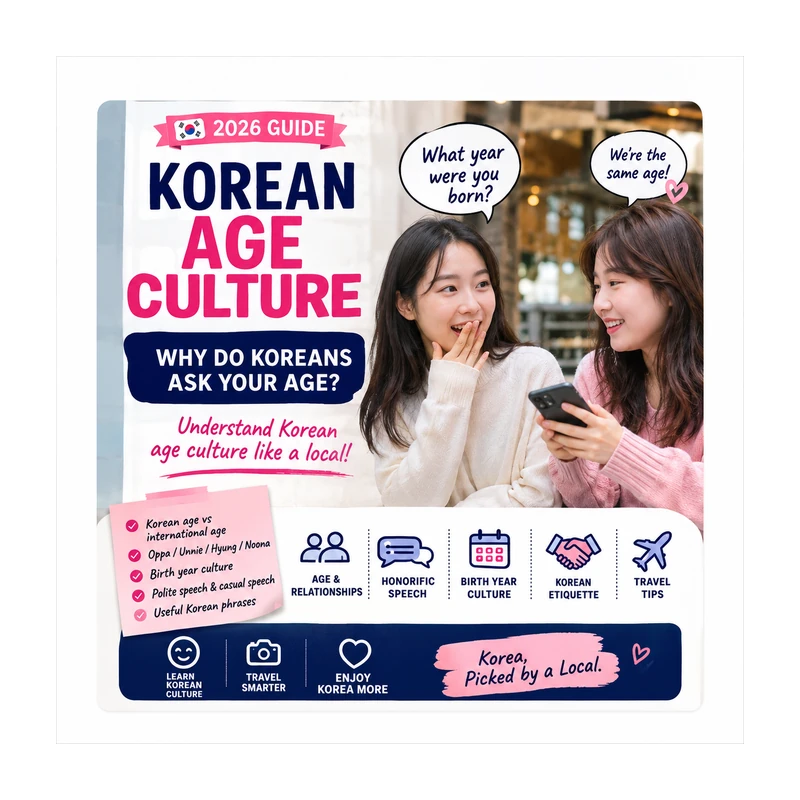
You’re having a friendly conversation with someone you just met in Korea.
You exchange names.
Maybe you talk about where you’re from.
And then suddenly:
“How old are you?”
If you come from a culture where asking someone’s age can feel personal or even rude, this might catch you off guard.
But in Korea, asking someone’s age — or more commonly, their birth year — can have a completely different meaning.
It’s not always about curiosity.
Traditionally, age helps Koreans understand how to address each other, what level of speech to use, and where two people stand socially.
And even though Korea changed its official age-counting system in 2023, the cultural importance of birth year didn’t suddenly disappear.
So why does age matter so much?
And what should you say if a Korean asks:
“What year were you born?”
Let’s break it down.
────────────────────
🎂 Why Is Age So Important in Korea?
To understand this, you need to know that Korean relationships have traditionally been influenced by hierarchy.
Age is one part of that.
Depending on the situation, Koreans may consider:
Age
School year
Job position
Seniority
and
Social relationship
when deciding how to speak to another person.
That’s because Korean has different speech levels.
The way you speak to:
a close younger friend
can be different from how you speak to:
someone older you’ve just met.
So when someone asks your age, they may essentially be trying to figure out:
“How should we talk to each other?”
────────────────────
🗣️ Korean Has Formal and Casual Speech
You’ve probably heard of:
존댓말 (Jondaetmal)
Polite or honorific speech.
And:
반말 (Banmal)
Casual speech.
When meeting someone for the first time, Koreans generally start with polite speech.
Age can then become one factor in deciding whether the relationship eventually becomes more casual.
For example, two people discover they’re the same age.
Someone might eventually suggest:
우리 말 놓을까요?
Uri mal noeulkkayo?
→ Shall we speak casually?
That can feel like a small milestone.
The relationship has just become a little closer.
────────────────────
👶 What Happens If You’re the Same Age?
This is where Korean culture gets interesting.
If two people are born in the same year, they may call each other:
동갑 (Donggap)
Meaning:
the same age.
You might hear:
우리 동갑이에요!
Uri donggabieyo!
→ We’re the same age!
Finding out you’re 동갑 can immediately make a conversation feel more relaxed.
Of course, that doesn’t mean two strangers instantly become best friends.
But it removes one layer of age hierarchy.
────────────────────
📅 Why Do Koreans Ask Your Birth Year Instead?
Instead of asking:
“How old are you?”
you may hear:
몇 년생이에요?
Myeot nyeonsaeng-ieyo?
→ What year were you born?
This is extremely useful to recognize.
Someone might answer:
2000년생이에요.
→ I was born in 2000.
Why ask the year instead of age?
One reason is simple:
Birth year makes age comparison easy.
And historically, Korea used multiple ways of counting age, which could make saying a numerical age surprisingly confusing.
────────────────────
🇰🇷 Wait — Didn’t Korea Get Rid of “Korean Age”?
Yes… but there’s an important distinction.
In June 2023, Korea implemented legal changes intended to standardize the use of the international age-counting system in administrative and civil contexts.
Under the international system:
You are 0 when you’re born, and your age increases on your birthday.
So the old stereotype:
“Everyone in Korea is automatically one or two years older.”
is no longer a good way to explain someone’s official age.
But that doesn’t mean age stopped mattering culturally.
────────────────────
🤔 So Does “Korean Age” Still Exist?
This is where overseas explanations can get confusing.
The traditional Korean age-counting method was:
1 year old at birth
everyone gains a year on January 1
That system is no longer the general legal standard.
However, everyday culture doesn’t change overnight.
People may still talk about:
birth year
school year
and whether someone is older or younger.
So if you’re visiting Korea in 2026, the safest way to think about it is:
Official age calculation changed. Age-based social culture didn’t disappear.
That’s why asking someone’s birth year can still happen naturally in social situations.
────────────────────
🧑🤝🧑 Why Does One Year Make Such a Difference?
Imagine two Korean friends.
One was born in:
1999
and the other in:
2000.
That’s only one year apart.
But depending on their relationship, the younger person might refer to the older person using terms such as:
형 (Hyung)
누나 (Noona)
오빠 (Oppa)
or
언니 (Unnie)
rather than simply using their first name.
For people unfamiliar with Korean culture, this can seem surprisingly significant.
────────────────────
👨 What Does “Hyung” Mean?
형 (Hyung)
is used by a male to refer to or address an older male with whom he has an appropriately close relationship.
For example:
A younger male friend may call an older male friend:
민수 형
instead of simply:
민수
You’ve probably heard this constantly in Korean dramas, variety shows, or K-pop content.
────────────────────
👩 What Does “Noona” Mean?
누나 (Noona)
is used by a male for an older female in an appropriately close relationship.
So:
Male → Older Female = 누나
This can refer to an actual older sister.
But it can also be used for a close older female friend or acquaintance depending on the relationship.
────────────────────
👩❤️👩 What Does “Unnie” Mean?
언니 (Unnie)
is used by a female for an older female.
Female → Older Female = 언니
Again, it can mean an actual older sister.
But you’ll also hear female friends use it with each other.
────────────────────
👨❤️👩 And What Does “Oppa” Actually Mean?
Ah yes.
오빠 (Oppa)
Probably one of the most internationally famous Korean words.
The basic relationship is:
Female → Older Male = 오빠
It can refer to:
An actual older brother
or
An older male with whom the speaker has an appropriately close relationship.
And yes, a woman may call her boyfriend 오빠 if he’s older.
But:
🚨 Important tourist warning
Don’t walk into Korea and start calling every attractive older Korean man:
OPPAAAA!
because you heard it in a K-drama. 😂
The word implies a relationship and social context.
It’s not simply Korean for:
“hot guy.”
────────────────────
📌 The Easy Cheat Sheet
Here’s the easiest way to remember it:
| Speaker | Older Person | Term |
|---|---|---|
| 👨 Male | 👨 Older male | 형 (Hyung) |
| 👨 Male | 👩 Older female | 누나 (Noona) |
| 👩 Female | 👩 Older female | 언니 (Unnie) |
| 👩 Female | 👨 Older male | 오빠 (Oppa) |
But there’s a very important rule:
Don’t automatically use these words just because someone is older than you.
Relationship and context matter.
If you’ve just met someone in a formal situation, using their title or polite form of address may be much more appropriate.
────────────────────
👶 What About Someone Younger?
A younger person can be described as:
동생 (Dongsaeng)
This literally refers to a younger sibling, but it can also describe someone younger with whom you have a close relationship.
You may also hear:
남동생
Younger brother
여동생
Younger sister
But unlike 형 / 누나 / 언니 / 오빠, you generally don’t call someone directly:
“Hey, dongsaeng!”
in the same way as those older-person terms.
────────────────────
🎓 Age Isn’t the Only Hierarchy in Korea
This is really important.
Korean social relationships aren’t determined by age alone.
Imagine:
Person A is 30 years old.
Person B is 28 years old.
But Person B has worked at the company longer.
Person B may be:
선배 (Seonbae)
→ Senior
while Person A is:
후배 (Hubae)
→ Junior
So now you have:
Age hierarchy
and
workplace seniority
existing at the same time.
Welcome to Korean social relationships. 😂
────────────────────
🎓 What Does “Seonbae” Mean?
선배 (Seonbae)
refers to someone who entered a school, organization, profession, or other shared environment before you.
후배 (Hubae)
refers to someone who came later.
You may recognize:
선배님 (Seonbaenim)
from Korean dramas.
The -님 (-nim) adds respect.
You’ll hear this especially in:
Schools
Universities
Workplaces
Entertainment
and other organizations.
────────────────────
🏫 What Was “Fast Age” in Korea?
If you’ve researched Korean age culture before, you may have encountered:
빠른년생
often translated loosely as “fast birth year” or “early-born.”
This came from Korea’s previous school-entry system.
Some people born early in a calendar year entered school with people born in the previous year.
For example, someone born early in one year might have gone through school with students born the year before.
This could create confusing situations:
“Technically I’m younger, but we were in the same school year.”
The system was phased out long ago, but adults who grew up under it may still occasionally mention it when explaining their age relationships.
PICK KNOW TIP
If someone starts explaining their 빠른년생 situation…
just smile and listen.
Some Koreans find it confusing too. 😂
────────────────────
🍻 Does Age Matter When Drinking?
Traditionally, age and hierarchy can also influence Korean drinking etiquette.
You may see younger people:
Pouring drinks for older people
Holding a glass with two hands
or
Turning slightly away while drinking in front of an elder
especially in more traditional or formal situations.
But don’t panic.
If you’re a foreign visitor having casual drinks with Korean friends, nobody should expect you to instantly understand every detail of Korean drinking etiquette.
A respectful attitude goes much further than memorizing 30 rules.
────────────────────
🙇 Do Foreigners Have to Follow Korean Age Hierarchy?
Not perfectly.
Koreans generally understand that international visitors come from different cultures.
Nobody reasonable expects you to arrive at Incheon Airport already knowing exactly when to say:
형
누나
언니
오빠
선배님
and which speech level to use.
If you’re unsure:
Use polite Korean.
That’s the safest option.
안녕하세요
감사합니다
and other polite expressions will take you a long way.
────────────────────
😳 Is Asking Someone’s Age Rude in Korea?
Not necessarily.
Context matters.
Among young adults meeting socially, asking birth year can be a normal way of understanding how everyone relates to each other.
But that doesn’t mean:
“Age is never a sensitive question in Korea.”
Age can still be personal depending on:
Who is asking
Why they’re asking
The person’s age
The setting
and
How the question is phrased.
So don’t take this article as permission to walk around asking every Korean stranger their age. 😂
────────────────────
🗣️ What Should I Say If Someone Asks My Age?
You have two easy options.
Option 1 — Give your age
저는 25살이에요.
Jeoneun seumuldaseot sarieyo.
→ I’m 25 years old.
Option 2 — Give your birth year
Often easier:
저는 2001년생이에요.
→ I was born in 2001.
For travelers, giving your birth year can actually avoid confusion.
────────────────────
🇰🇷 Useful Korean Age Phrases
Save these:
| Korean | Meaning |
|---|---|
| 몇 살이에요? | How old are you? |
| 몇 년생이에요? | What year were you born? |
| 저는 2000년생이에요 | I was born in 2000 |
| 동갑이에요 | We’re the same age |
| 저보다 한 살 많아요 | You’re one year older than me |
| 저보다 한 살 어려요 | You’re one year younger than me |
| 우리 말 놓을까요? | Shall we speak casually? |
| 형 | Older male, used by a male |
| 누나 | Older female, used by a male |
| 언니 | Older female, used by a female |
| 오빠 | Older male, used by a female |
You don’t need to memorize all of this before traveling.
Just recognizing 몇 년생이에요? can be surprisingly useful.
────────────────────
📺 Why K-Dramas Make More Sense Once You Know This
Understanding Korean age culture can actually change how you watch Korean dramas.
Suddenly you understand why a character gets surprised when someone says:
“We’re the same age.”
Or why changing from:
formal speech
to
casual speech
feels like a big moment.
Or why someone hesitates before calling another character:
오빠
or
형.
English subtitles can’t always fully communicate these relationship changes.
The dialogue may still translate simply as:
“Hey.”
But in Korean, the way they’re speaking to each other may have completely changed.
────────────────────
🎤 You’ll Notice It in K-Pop Too
If you follow K-pop groups, you’ve probably already encountered age hierarchy without realizing it.
Members may talk about:
형라인
→ Older male members
or
막내
→ Youngest member
막내 (Maknae)
is another Korean word international fans often recognize.
It simply means:
the youngest person in a group or family.
The youngest member isn’t necessarily treated like a baby, of course.
But age relationships often become part of the group’s dynamic.
────────────────────
🤝 When Can You Start Speaking Casually?
Don’t automatically switch to casual speech just because you discover someone is younger.
This is a common misunderstanding.
Age is only part of the equation.
Relationship and context still matter.
If you’ve just met someone:
Start politely.
If the relationship becomes friendly, one person may suggest switching to casual speech.
That’s much safer than deciding:
“You’re younger than me, so I’m using banmal now.”
Don’t do that. 😂
────────────────────
❌ Common Mistakes Visitors Make
1. Thinking Korea still officially uses only “Korean age”
International age is the general legal and administrative standard.
2. Thinking age no longer matters at all
The legal calculation changed.
The culture didn’t disappear overnight.
3. Calling every older Korean man “oppa”
Please don’t. 😂
4. Using casual speech because someone is younger
Start politely unless the relationship says otherwise.
5. Assuming age determines everything
Seniority, titles, relationship, and setting matter too.
6. Getting offended immediately when someone asks your birth year
They may simply be trying to understand how to interact with you.
────────────────────
⭐ The Simplest Way for Tourists to Handle Korean Age Culture
You don’t need a textbook.
Remember four things:
① Start with polite speech
You can’t go far wrong.
② If someone asks your birth year, don’t be surprised
It’s relatively normal in certain social situations.
③ Don’t use Oppa / Unnie / Hyung / Noona automatically
Wait until you understand the relationship.
④ Don’t worry about mastering everything
Koreans know you’re a visitor.
Respect matters more than perfection.
That’s it.
────────────────────
🇰🇷 The Bigger Idea Behind Korean Age Culture
Ultimately, Korean age culture isn’t really about the number itself.
It’s about relationships.
When someone asks:
“몇 년생이에요?”
they may not simply be asking:
“How many years have you been alive?”
They’re also trying to understand:
Are we the same age?
Should we speak politely?
How should I address you?
What kind of relationship do we have?
Once you understand that, the question starts to make much more sense.
────────────────────
Final Thoughts
Korea’s age culture can seem surprisingly complicated from the outside.
There was the traditional Korean age system.
There’s international age.
There are birth years.
Then you have:
Hyung
Noona
Unnie
Oppa
Seonbae
Hubae
and different speech levels on top of everything.
But as a traveler, you don’t need to master all of it.
If you remember just one rule, make it this:
Start politely and let the relationship develop naturally.
And if someone you’ve just met suddenly asks:
몇 년생이에요?
you’ll now know they’re asking:
“What year were you born?”
Not necessarily:
“Why are you so old?” 😂
Last updated: August 2026
Age-related language and etiquette vary depending on relationship, setting, generation, and individual preference. Korea’s international age system is the general legal and administrative standard, while birth-year and age-based social conventions can still appear in everyday life.
PICK KNOW — Korea, Picked by a Local.
Leave a Reply