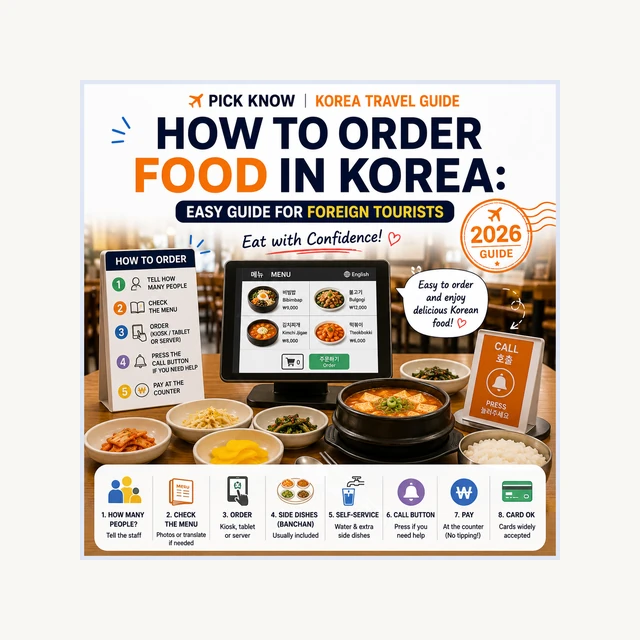
Walking into a Korean restaurant for the first time can feel a little intimidating.
The menu might be in Korean.
There may be a touchscreen instead of a waiter.
You might see a button on the table and have no idea what it does.
And then several small dishes suddenly appear even though you never ordered them.
Don’t worry.
Ordering food in Korea is usually much easier than it looks.
Once you understand a few basic things, eating at local Korean restaurants can become one of the most enjoyable parts of your trip.
Here’s how to order food in Korea as a first-time visitor in 2026.
────────────────────
1. Entering a Korean Restaurant
When you enter, a staff member may greet you and ask how many people are in your group.
You can simply show the number with your fingers or say:
One person → Han myeong (한 명)
Two people → Du myeong (두 명)
Three people → Se myeong (세 명)
Four people → Ne myeong (네 명)
In many casual restaurants, staff will simply show you where to sit.
Some restaurants may also have a waiting kiosk near the entrance, especially popular or busy locations.
If you’re traveling alone, don’t worry.
Solo dining is increasingly easy in Korea, although some Korean BBQ restaurants or dishes designed for sharing may require a minimum order.
────────────────────
2. Check the Menu Before Ordering
Tourist areas often have English menus, pictures, or both.
But smaller neighborhood restaurants may only have Korean menus.
If that happens, your phone can help.
Translation apps can recognize Korean text from images, making it much easier to understand a menu.
Korea’s official tourism website specifically recommends Papago as a useful translation tool, including its ability to recognize text and Korean food names from images.
PICK KNOW TIP
Take a photo of the menu and use image translation instead of trying to type every Korean word manually.
It can save a lot of time.
────────────────────
3. How Do You Actually Order?
There isn’t one universal ordering system in Korea.
Depending on the restaurant, you might order:
With a server
Using a touchscreen kiosk
Using a tablet at your table
By scanning a QR code
At traditional restaurants, you may simply tell the staff what you want.
At newer restaurants, cafés, fast-food restaurants, and casual chains, digital ordering systems are increasingly common. Korea Tourism Organization also notes the growing use of unmanned ordering machines in restaurants.
If the screen has an English-language option, look near the top or bottom corners.
You may see:
English
Language
or a globe 🌐 icon.
────────────────────
4. What’s the Button on the Table?
You may notice a small button attached to your table.
That’s usually the call button.
Instead of constantly trying to make eye contact with a server, press the button when you need assistance.
The staff will come to your table.
Korean restaurants commonly use these buttons, and Korea’s official tourism guide specifically points them out as a normal restaurant feature.
So don’t sit there for ten minutes wondering why nobody is coming.
Press the button.
That’s what it’s there for.
────────────────────
5. Don’t Be Surprised by the Side Dishes
You order one meal.
Then suddenly:
Kimchi.
Pickled radish.
Vegetables.
Sauces.
Several mysterious little plates.
Welcome to banchan (반찬).
Banchan are Korean side dishes served alongside your meal.
You usually don’t need to order them individually.
The exact selection depends on the restaurant and what you’re eating.
At some restaurants, additional side dishes are available from a self-service station.
So if several dishes arrive that you didn’t order, don’t panic.
You probably haven’t accidentally doubled your bill.
────────────────────
6. Look for a Self-Service Area
The words:
셀프
mean self-service.
You may see a self-service station containing things like:
• Water
• Kimchi
• Pickled radish
• Additional side dishes
• Napkins
• Utensils
If you see other customers getting their own water or side dishes, that’s a good clue.
Not every restaurant works this way, so look around before repeatedly calling the staff.
────────────────────
7. Where Are the Chopsticks and Spoons?
Another first-time Korea moment:
Your food arrives.
But where are the chopsticks?
Look underneath or beside the table.
Many Korean restaurants have a small drawer built into the table containing:
Chopsticks
Spoons
Napkins
The Korea Tourism Organization even highlights these utensil drawers as a common feature of Korean restaurants.
If there isn’t a drawer, utensils may already be on the table or provided by the staff.
────────────────────
8. What If the Food Is Too Spicy?
Korean food isn’t automatically spicy.
But some dishes definitely are.
If you’re sensitive to spicy food, it’s worth checking before ordering.
You can ask:
“Is this spicy?”
Or show the Korean phrase:
이거 매워요?
(Igeo maewoyo?)
Meaning:
“Is this spicy?”
You can also ask:
안 맵게 해주세요.
(An maepge haejuseyo.)
Meaning:
“Please make it not spicy.”
However, some dishes use a sauce or recipe that can’t easily be changed.
If you’re unsure what to order, our guide What to Eat in Korea: 10 Must-Try Korean Foods for First-Time Visitors is a good place to start.
────────────────────
9. Korean BBQ Works a Little Differently
Korean BBQ deserves special mention.
At some restaurants, you grill the meat yourself.
At others, staff may cook it for you.
You’ll typically receive:
• Meat
• Lettuce or other leafy vegetables
• Garlic
• Sauces
• Kimchi
• Side dishes
A common way to eat Korean BBQ is to make a ssam:
Lettuce + meat + sauce + garlic → wrap → eat
One important thing to check is the minimum order.
Some Korean BBQ restaurants require at least two portions of meat, even if you’re dining alone.
Check the menu before ordering.
────────────────────
10. Do You Need to Tip in Korea?
Usually, no.
Tipping is not generally expected at ordinary Korean restaurants.
You normally pay the amount shown on your bill without calculating an additional percentage for your server.
The Korea Tourism Organization also states that tipping is not required or expected in Korean restaurants.
For visitors coming from countries where 15–25% tips are common, this can feel unusual at first.
But in Korea, simply paying your bill is normally enough.
────────────────────
11. How Do You Pay?
At many Korean restaurants, you don’t wait at your table for someone to bring the bill.
Instead:
Finish eating → Walk to the counter → Pay
Some restaurants use kiosks or table-order systems that handle payment differently.
Cards are widely used throughout Korea, but international card acceptance can still vary depending on the merchant and payment system.
If you’re unsure about using your foreign card, read:
Can You Use a Credit Card in Korea? What Tourists Need to Know in 2026
Keeping a small amount of Korean won available can also be useful as a backup.
────────────────────
12. Can You Split the Bill?
If you’re eating with friends, don’t automatically assume the restaurant will split one table’s bill across several cards in exactly the way you’re used to at home.
Policies and payment systems vary.
A simple solution is often:
One person pays → Everyone settles up afterward
Some restaurants may accommodate separate payments, but it’s better to ask rather than assume.
────────────────────
13. What Does “1인 1메뉴” Mean?
You may occasionally see:
1인 1메뉴
This means approximately:
One menu item per person.
In other words, the restaurant expects each customer to order something.
You might encounter similar minimum-order rules at cafés and restaurants.
Another common rule at BBQ restaurants is a minimum number of meat portions.
If you’re unsure, ask the staff before ordering.
────────────────────
14. Can Foreign Tourists Make Restaurant Reservations?
Yes, although reservation systems can sometimes be more complicated for international visitors.
Some Korean reservation and waiting systems require a Korean phone number.
However, tourist-oriented services have made this easier. Korea Tourism Organization notes that Catchtable Global allows foreign users to access restaurant reservations without a Korean phone number and supports foreign-issued cards.
For very popular restaurants, checking reservation requirements before arriving can save you a long wait.
────────────────────
15. Useful Korean Restaurant Phrases
You don’t need to speak Korean to enjoy eating in Korea.
But a few phrases can be helpful.
Jeogiyo (저기요)
→ Excuse me / used to get a server’s attention
Igeo juseyo (이거 주세요)
→ This one, please
Igeo maewoyo? (이거 매워요?)
→ Is this spicy?
Mul juseyo (물 주세요)
→ Water, please
Gyesanhalgeyo (계산할게요)
→ I’d like to pay
Gamsahamnida (감사합니다)
→ Thank you
Don’t worry about perfect pronunciation.
Pointing at the menu while saying “Igeo juseyo” can get you surprisingly far.
────────────────────
Common First-Time Mistakes
A few things confuse visitors again and again.
Waiting for a bill at the table
You may need to pay at the counter.
Not noticing the call button
Use it when you need the staff.
Looking everywhere for chopsticks
Check the table drawer.
Thinking banchan were accidentally ordered
They’re usually part of the meal.
Ordering something without checking the spice level
That bright red sauce may be trying to tell you something.
Assuming every restaurant has the same ordering system
Kiosks, tablets, servers, and self-service systems can all be used.
────────────────────
Your First Korean Restaurant: Do This
If you’re nervous, keep it simple.
Walk in.
Tell the staff how many people are dining.
Sit where they direct you.
Check the menu.
Use translation if necessary.
Order with the server, kiosk, or tablet.
Look for the utensil drawer.
Enjoy the banchan.
Press the call button if you need help.
When you’re finished, check whether payment is made at the counter.
That’s basically it.
────────────────────
Eating in Korea Is Easier Than It Looks
Your first Korean restaurant might feel confusing for five minutes.
By your third or fourth meal, you’ll probably stop thinking about it.
You’ll automatically check underneath the table for chopsticks.
You’ll recognize 셀프.
You’ll press the call button without hesitation.
And you’ll know that the little plates appearing around your meal are probably banchan.
Don’t let the language barrier stop you from trying local restaurants.
Pointing, translating, smiling, and saying “Igeo juseyo” are often more than enough.
And once you’re comfortable ordering, an enormous part of Korean food culture opens up to you.
Enjoy your meal!
Last updated: August 2026
Restaurant ordering systems, payment methods, reservation requirements, menu availability, and individual restaurant policies may vary. Check current information at the restaurant when necessary.
PICK KNOW
Korea, Picked by a Local.
Leave a Reply